

Project Overview
In modern fulfillment centers, operational efficiency hinges on optimizing the friction points between manual human operations and physical material handling equipment. Working alongside Amazon Egypt, our engineering team “Aisle Runners” set out to resolve a critical operational bottleneck in high-density storage zones.
Standard fulfillment trolleys, designed for traditional 120 cm aisles, were dimensionally incompatible with high-density 90 cm narrow aisles. Associates were forced to park carts outside the aisles and manually hand-carry totes back and forth, resulting in significant operational downtime, physical strain, and heightened risk of product damage. This case study details the mechanical architecture, ergonomic compliance, and spatial trajectory optimization of the Next-Gen Fulfillment Cart.
Problem Definition
Fulfillment operations in 90 cm narrow aisles suffered from severe mechanical and logistical constraints:
- Dimensional Incompatibility: Legacy trolleys (designed for 120 cm aisles) physically could not enter 90 cm aisles.
- Excessive Manual Handling: Associates had to hand-carry units across the aisle, increasing time, effort, and injury risk.
- Operational Latency: Constant back-and-forth trips created significant associate idle time.
Design Objectives
To solve these systemic challenges, our engineering objectives were established:
- Narrow Aisle Mobility: Design a new trolley capable of navigating 90 cm wide aisles.
- Volumetric Capacity: Maximize unit capacity without compromising cart stability.
- Ergonomic Safety: Ensure unit safety and reduce risk of associate injury and product damage.
- Single-User Operation: Maintain single user’s operation seamlessly.
Kinematic & Trajectory Feasibility Analysis
To quantify the inefficiency of the baseline workflow, we performed a study comparing the baseline manual retrieval process against a direct-entry trolley workflow across a standardized 10 m aisle.
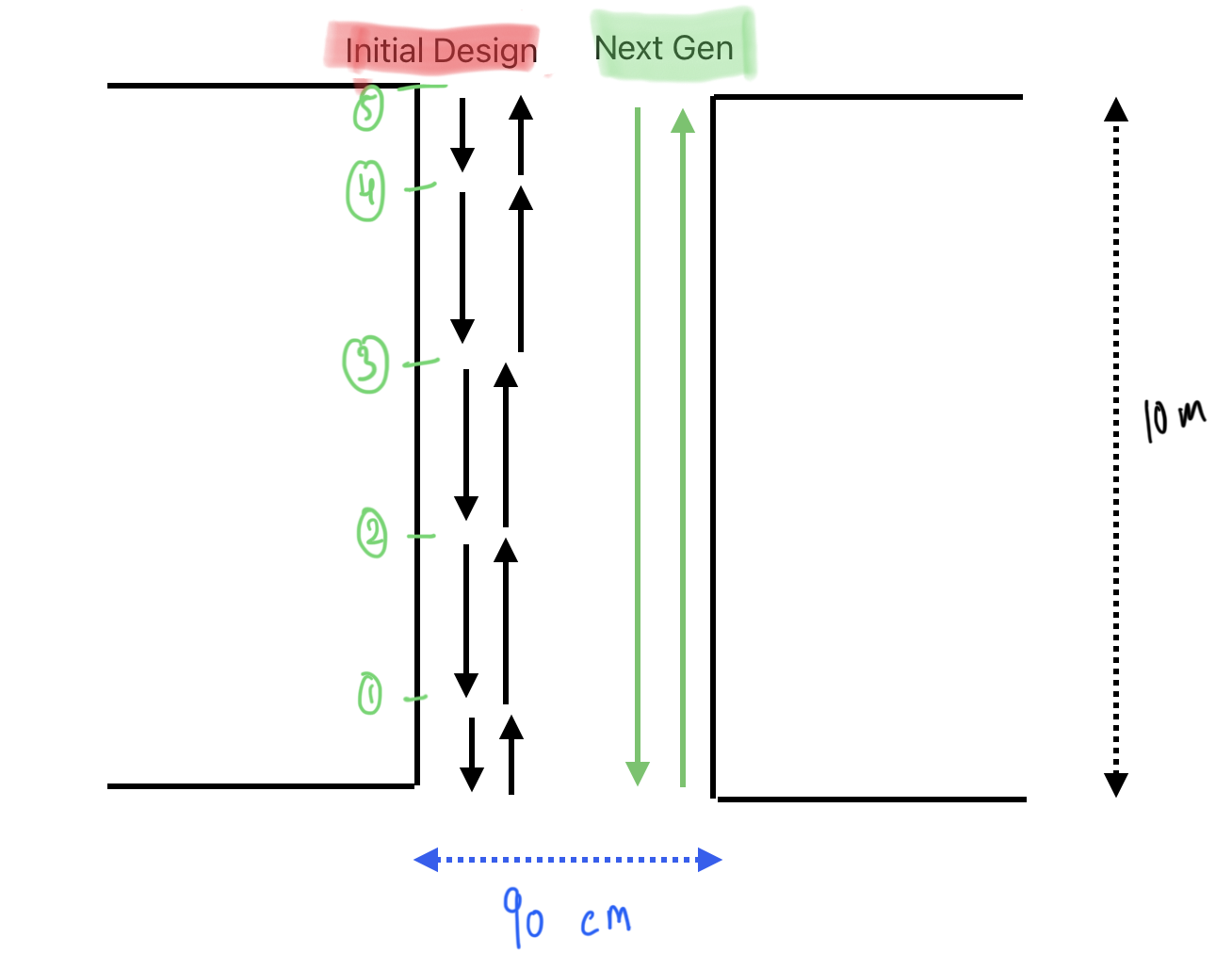
Quantitative Breakdown
In the legacy staging model, associates parked the cart outside and walked back and forth along the 10 m aisle:
With the Next-Gen cart entering the 90 cm aisle directly:
Efficiency Gains
By enabling direct aisle entry, aisle round-trip time was cut from 60 seconds to 10 seconds, achieving an 83% reduction in idle time.
Next-Gen Cart Mechanical Architecture (Deliver Results — Amazon LP14)
Transforming the cart from a wide profile into a slim, high-capacity fulfillment vehicle required a complete ground-up structural redesign. Wish I could provide a visual of the CAD model here, but the key mechanical innovations are summarized below to maintain confidentiality.
Generational Mechanical Comparison
| Feature | Legacy Trolley | Next-Gen Cart |
|---|---|---|
| Aisle Clearance | Designed for 120 cm aisles (incompatible with 90 cm) | Custom footprint engineered for 90 cm narrow aisles |
| Tote Staging | Side-by-side tote orientation | Front-to-back tote orientation |
| Accessibility | Fixed shelf trays | Sliding drawer shelves with 30 cm stoppers |
| Visibility | Standard vertical stack | Shortened top two shelves for enhanced sightlines |
| Safety Standard | Standard baseline | ISO 11228-1 compliant (manual handling safety) |
Key Mechanical Innovations & Safety Engineering
1. Narrow Aisle Footprint & Tote Reorientation
The primary innovation enabling access to 90 cm aisles was reorienting tote placement from side-by-side to front-to-back.
- Width Reduction: Reorienting totes to a front-to-back configuration significantly reduces the trolley’s overall width, granting full mobility in 90 cm aisles.
- Capacity Retention: Preserves maximum unit payload capacity across multi-tiered shelf levels.
2. Enhanced Tote Accessibility & Visibility
To overcome depth reach challenges associated with front-to-back stacking, we integrated dynamic drawer mechanics and optimized shelf lengths.
- Sliding Drawer Trays: Implemented shelves as drawers to drastically improve reachability of totes, particularly those on the middle and bottom levels.
- Shortened Top Shelves: Shortened the top two shelves while maintaining a two-tote capacity to further enhance sightlines and access into lower tiers.
3. Structural Stability & ISO 11228-1 Ergonomic Compliance
Safety and structural integrity were validated under ISO 11228-1 (Manual Handling Safety Technique) to protect operators and inventory.
- 30 cm Drawer Extension Stoppers: Added mechanical stoppers to each drawer shelf, capping extension at exactly 30 cm to maintain stability during stowing and motion.
- Reinforced Support Columns: Relocated and increased the number of vertical support columns to eliminate access interference while enhancing structural strength and user safety.
- Injury & Damage Mitigation: Abiding by ISO 11228-1 standards significantly reduces associate injury risks and product damage during handling.